Single-Cell vs. Double-Cell Shades: What Changes in a Real Room?
A second layer of cells can add insulation, but cell count does not decide light control, room darkening, window fit, or operating options by itself.
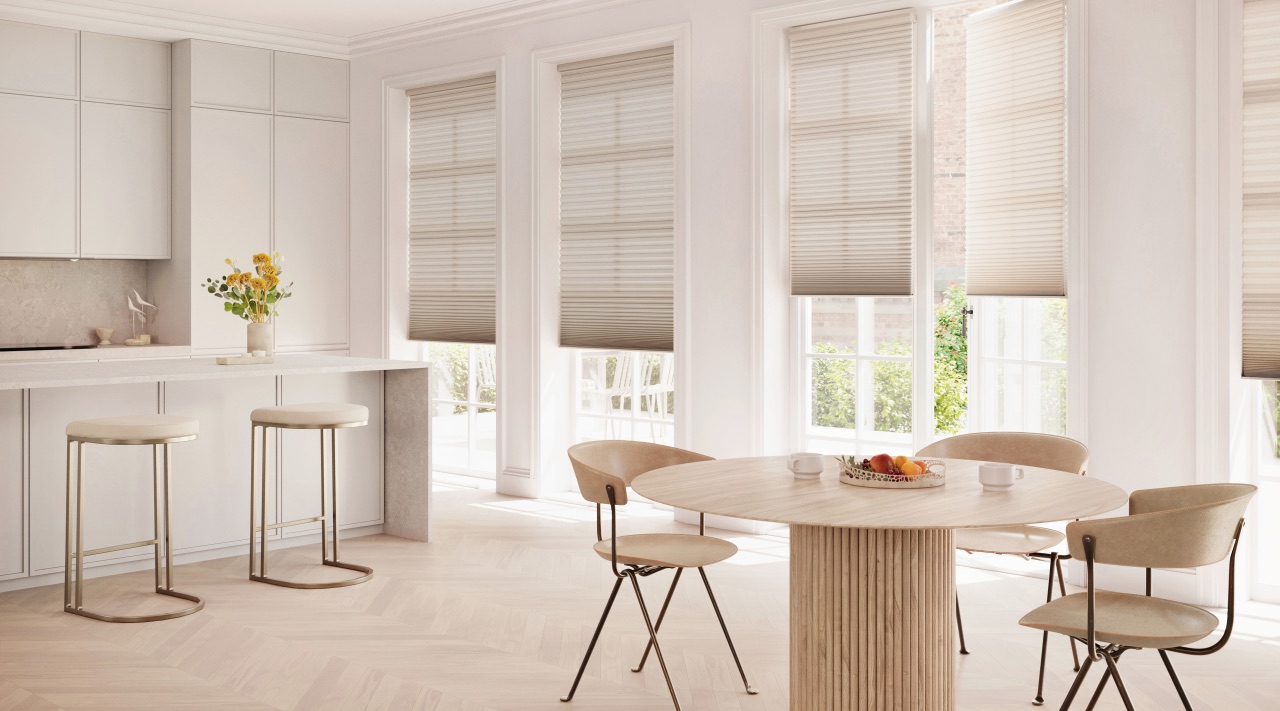
The difference between single-cell and double-cell cellular shades is easiest to see from the side. A single-cell shade has one row of honeycomb-shaped air pockets. A double-cell shade has two rows. Some premium constructions use a honeycomb within another honeycomb rather than two equal rows. All three designs use trapped air to add insulation at the window, but they do not perform identically.
That construction matters, especially when comfort is the main reason for choosing a cellular shade. It is still only one part of the decision. Fabric opacity, pleat size, window dimensions, mounting depth, operating system, and installation all affect how the finished shade looks and works.
For most homes, the useful question is not simply which shade has more cells. It is which complete configuration fits the window and the room.
The short answer
A single-cell shade is often the practical starting point when you want cellular insulation with a broad choice of fabrics, pleat sizes, and controls. A double-cell or cell-within-a-cell shade adds fabric layers and insulating pockets, which can improve insulation compared with a comparable single-cell construction.
That does not make the multi-layer option better for every window. More material can change the depth, stack, weight, size limits, available fabrics, and compatible operating systems. Those details vary by product and configuration, so they need to be checked against the measurements for the actual opening.
Neither cell count automatically determines privacy or darkness. A light-filtering double-cell shade can admit more light than a room-darkening single-cell shade. Fabric opacity and edge gaps usually matter more when darkness is the goal.
Why "double cell" and "cell within a cell" need clarification
The terms are often grouped together, and some sellers use "double cell" as a broad label for any shade with more than one insulating pocket. It helps to separate the underlying constructions:
- A single-cell shade has one row of enclosed air pockets.
- A double-cell shade has two connected rows of cells.
- A cell-within-a-cell shade places one honeycomb inside another, adding fabric layers and air pockets in a different geometry.
Hunter Douglas describes Duette® Honeycomb Shades as single cell and Duette® Architella® as honeycomb within a honeycomb. DLUX's current Applause® Honeycomb page identifies that line as a double-cell design.
Those family names should not be treated as interchangeable. Fabric collections, sizes, pleat dimensions, control choices, and enhancements differ. Current availability should be confirmed for the exact window rather than assumed from the construction name alone.
How the two constructions compare
| Decision factor | Single-cell starting point | Double-cell or cell-within-a-cell starting point |
|---|---|---|
| Insulation | Traps air in one row of cells and adds insulation at the glass | Adds air pockets and fabric layers for stronger insulation in comparable configurations |
| Light control | Depends on the selected fabric and opacity | Also depends on fabric and opacity; more cells do not automatically make the room darker |
| Window depth and fit | May work where a simpler profile is helpful | Added layers may require different depth, hardware, or size limits |
| Raised stack | Varies by pleat size, fabric, shade height, and control | More material may change the stack; compare the actual specification |
| Appearance | Pleat scale can read clean and simple | Added construction may look fuller from the side |
| Operation | Manual and automated choices depend on the product | Compatibility can narrow by fabric, size, and construction |
| Best reason to choose it | You want cellular insulation and flexibility without paying for layers you do not need | Window comfort is a higher priority and the selected configuration fits the opening |
This table is a starting point, not a substitute for product specifications. A large single-cell shade in one fabric can have different limits than a smaller double-cell shade in another.
How construction affects insulation
Cellular shades insulate by holding air in enclosed pockets. A design with more fabric layers and insulating pockets can provide greater resistance to heat moving through the window than a comparable single-cell design.
That can be useful in a room with cold glass during winter or one that receives strong afternoon sun. The shade still works as one part of the window assembly. Glass type, frame condition, air leakage, shade fit, fabric, mount, and how often the shade is open all affect the result.
For that reason, a product label should not be turned into a promised percentage of savings. Compare exact constructions and any available energy rating for the selected fabric and size. Choose double cell when the added insulation is useful enough to justify its fit and cost, not because of a blanket claim that it will lower a bill by a certain amount.
Cell count does not decide how dark the room gets
This is where many single-cell versus double-cell guides go wrong. More cells do not automatically block more light.
Light-filtering fabric is designed to admit softened daylight. Room-darkening fabric blocks most incoming light through the material. The finished room also has light at the edges, especially with an inside mount that needs operating clearance. An outside mount, drapery side panels, or a qualifying side-channel system may reduce that glow, but the selected fabric and installation still determine the result.
If the shade is for a bedroom, nursery, or media room, make these decisions separately:
- Choose the cellular construction for the insulation and fit you need.
- Choose the fabric opacity for the desired amount of daylight and privacy.
- Review the mount and edge gaps before deciding how dark the room will feel.
- Ask whether a room-darkening enhancement is available for that product, fabric, size, and control.
Selected Duette configurations may be paired with the LightLock® system, whose side channels are designed to reduce incoming light at the edges. It is an optional, configuration-dependent enhancement rather than a feature of every cellular shade.
For a deeper explanation, read Room Darkening vs. Blackout Shades: The Real Difference.
Pleat size and window scale still matter
The face of a cellular shade is defined by its pleats. A wider pleat can feel more in scale with a broad or tall window. A smaller pleat can create a tighter texture. Construction and pleat size are separate specifications, so "double cell" should not be used as shorthand for one particular look.
Current Duette cellular shades include selected ¾-inch and 1¼-inch pleat options, but not every fabric or enhancement comes in every pleat size. The right proportion depends on the window, the fabric, and what the shade looks like next to the trim, furnishings, and other treatments in the room.
This is one reason a side-by-side sample comparison is more useful than choosing from a construction label online.
Window size, mounting depth, and stack can change the answer
A double-cell shade is not automatically the right choice for a large window. Added material can affect weight and the amount of fabric gathered when the shade is raised. A single-cell product with the right pleat and operating system may be the better fit for one wide opening, while a multi-layer construction may work well on a different opening.
Before selecting either one, confirm:
- inside-mount depth and hardware clearance;
- finished width and height;
- raised stack and the view you want when open;
- handles, cranks, trim, and other obstructions;
- manual or motorized operation;
- access for charging or battery service, if applicable;
- fabric, color, and opacity availability in the required size.
A custom measurement connects all of those decisions. Cell count by itself does not.
Operation is a separate choice
Cellular construction describes the fabric, not how the shade moves. Depending on the product and configuration, options may include cordless manual operation, top-down or top-down/bottom-up movement, or PowerView® Automation. Hunter Douglas lists several operating enhancements for selected Duette configurations, but none should be assumed to apply across every fabric, size, or cell construction.
If automation is part of the plan, confirm the product family, size, movement, power source, and controls before ordering. You can also compare custom motorized shade options separately from the cellular construction.
Are double-cell shades worth it?
Double-cell or cell-within-a-cell shades are worth considering when insulation is one of the room's highest priorities and the added construction fits the opening. They can make sense for exposed windows, rooms that feel less comfortable near the glass, and homes where the shades will be closed during the hottest or coldest parts of the day.
Single-cell shades remain worth comparing when their fabric, pleat size, operation, stack, and fit suit the window. Price cannot be inferred from cell count alone, so compare complete configurations quoted for the opening.
Where the construction choice matters most
In bedrooms, choose opacity and address edge light separately from cell construction. In rooms with cold glass or strong sun, compare the insulation, fit, and operation of the exact single- and multi-layer options. For large or specialty-shaped openings, confirm size and operating limits before choosing by cell count.
Compare cellular shade samples with DLUX
The clearest way to choose between single-cell, double-cell, and cell-within-a-cell shades is to see the side profiles, fabrics, pleat sizes, and controls together. Explore cellular and honeycomb shades from DLUX, including Applause® Honeycomb Shades, then confirm which configurations are currently available for your measurements.
Visit the Keystone Reno showroom, South Reno showroom, Sparks showroom, or Truckee showroom. You can also contact DLUX before choosing a configuration.
Frequently asked questions
Do double-cell shades block more light than single-cell shades?
Not necessarily. Fabric opacity, color, mount, and edge gaps have more direct influence on visible light than cell count. A room-darkening single-cell fabric may make a room darker than a light-filtering double-cell fabric.
Are double-cell shades always more energy efficient?
A multi-layer cellular construction can provide more insulation than a comparable single-cell option because it adds fabric layers and air pockets. Exact performance still depends on the complete product configuration, window, fit, installation, and operation.
Is cell within a cell the same as double cell?
The terms are sometimes used loosely, but the constructions are not identical. Traditional double-cell construction uses two connected rows of cells. Cell-within-a-cell construction places one honeycomb inside another. Both add insulating pockets, but their geometry and product availability differ.
Are double-cell shades better for large windows?
Not automatically. More fabric can change weight, stack, hardware, and size limits. Measure the opening and compare the exact specifications before choosing a construction.
Can single-cell and double-cell shades be motorized?
Motorization may be available on selected cellular products and configurations. Compatibility depends on the product family, fabric, size, cell construction, movement, and power option. Confirm all of those details for the opening before ordering.
Do I need room-darkening fabric if I choose double cell?
Choose room-darkening fabric based on the amount of light you want to block, not on cell count. A double-cell light-filtering fabric is still intended to admit light. Edge gaps and mounting also affect the final result.
See the samples in your own light.
Every window reads differently at 6,200 feet. We bring the full range to your home and measure while we're there — no charge, no obligation.
Book a free in-home visitExplore these window treatments
Every product below is available to see and operate in person at our Reno, Sparks and Truckee showrooms, with a complimentary in-home consultation and measurement before you order.
- Motorized ShadesHunter Douglas PowerView® shades you control by app, voice or schedule.
- Cellular Honeycomb ShadesDuette® honeycomb shades, from light-filtering to room-darkening fabrics.
- Plantation ShuttersMade-to-measure interior shutters in wood and composite.
- Roller ShadesClean, modern roller shades in light-filtering and blackout fabrics.
- Solar Screen ShadesSolar shades that cut glare while keeping your view.
- Custom DraperyCustom drapes and curtains sewn in designer fabrics, with hardware and installation.
- Vertical BlindsSomner® vertical blinds for sliding doors and tall windows.
- Wood BlindsReal hardwood blinds in custom stains and paint finishes.
- Woven Wood ShadesProvenance® woven wood shades in natural reeds, grasses and bamboo.
- MagnaTrack Motorized ScreensMotorized retractable patio screens on a patented magnetic track.